ABANDONED 100-ROOM MANSION IN PENNSYLVANIA.
Lynnewood Hall: A Majestic Historic Landmark in Philadelphia, Pennsylvania
Nestled in the picturesque suburbs of Philadelphia, Pennsylvania, Lynnewood Hall stands as a grand testament to the opulence and elegance of the Gilded Age.
With its stately architecture, rich history, and stunning grounds, this former estate has earned a place among the most iconic historic properties in the region.
The mansion, once a private residence of one of the wealthiest families in America, offers a glimpse into a time when lavishness and grandeur were the epitome of success and power.
In this article, we will explore the history, architectural features, and significance of Lynnewood Hall, highlighting its importance as a cultural and historical landmark in Philadelphia.
Historical Background
Lynnewood Hall was constructed between 1897 and 1900 for industrial magnate and philanthropist, Peter A.B. Widener, and his family.
Widener made his fortune as a major investor in the streetcar industry, as well as in the coal, steel, and transportation sectors.
A man of immense wealth, Widener sought to build a residence that reflected his status and success. He chose a 33-acre site in the affluent suburb of Elkins Park, just outside of Philadelphia, for his grand estate.
The mansion was designed to serve as a lavish family home and a symbol of Widener’s social standing.
The estate was named “Lynnewood Hall” in honor of the nearby Lynnewood Hotel, which had once been a popular resort destination.
Widener’s vision for the property was to create a residence that would rival the great mansions of Europe, both in scale and design.
To bring his vision to life, he hired the prominent architect Horace Trumbauer, who was renowned for his work on other grand estates, including the Philadelphia Museum of Art.
Trumbauer’s design for Lynnewood Hall drew inspiration from classical European styles, combining elements of French Renaissance and Beaux-Arts architecture to create a stately and timeless structure.
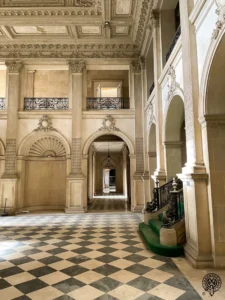 Great hall facing West scaled
Architecture and Design
Lynnewood Hall is an extraordinary example of Beaux-Arts architecture, characterized by its symmetry, grandeur, and use of classical elements.
The mansion spans a staggering 110,000 square feet, making it one of the largest private homes ever built in the United States.
The exterior of the mansion features a limestone façade adorned with intricate carvings, columns, and balustrades, all of which contribute to the building’s majestic appearance.
The central entrance of Lynnewood Hall is marked by a grand portico with six towering Corinthian columns, which support a pediment decorated with elaborate sculptural details.
The portico leads into a spacious foyer, which sets the tone for the opulence that lies within. Inside, the mansion boasts 110 rooms, including multiple bedrooms, bathrooms, drawing rooms, libraries, and ballrooms, each more lavish than the last.
The interior spaces are designed with luxurious materials such as marble, oak, and mahogany, and feature intricate moldings, stained glass windows, and ornate fireplaces.
One of the most impressive features of Lynnewood Hall is its grand staircase, which rises to the second floor in a sweeping curve.
The staircase is flanked by towering columns and is adorned with a stunning wrought-iron railing. The design of the staircase is a key element of the mansion’s overall aesthetic, emphasizing both elegance and grandeur.
In addition to the main staircase, the mansion also features a series of smaller, more private staircases, ensuring that the Widener family and their guests could move about the estate with ease and privacy.
The mansion’s grounds are equally impressive, with manicured gardens, expansive lawns, and several outbuildings, including a carriage house and a gatehouse.
The property was originally designed to reflect the ideals of classical European estates, with perfectly aligned hedges, fountains, and sculptures scattered throughout the grounds.
The estate also includes a series of walking paths and terraces that offer breathtaking views of the surrounding landscape.
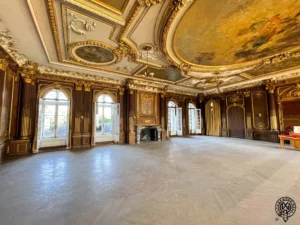 The Ballroom
The Wideners and Their Legacy
The Widener family played a significant role in both the history of Lynnewood Hall and the broader history of Philadelphia. Peter A.B. Widener, who commissioned the mansion’s construction, was a prominent figure in the city’s social and business circles.
His son, George D. Widener, also contributed to the family’s prominence by becoming an important philanthropist and financier. However, it was George’s tragic death in the sinking of the Titanic in 1912 that cast a shadow over the family’s legacy.
George D. Widener, along with his wife, Eleanor, and son, Harry, were aboard the ill-fated ship when it struck an iceberg and sank. George and Harry both perished in the disaster, while Eleanor survived.
The loss of George was a devastating blow to the Widener family and to the estate, as it was he who had been responsible for much of the family’s philanthropic work.
In his memory, the family established the Widener Memorial Library at Harvard University, which remains one of the largest academic libraries in the world.
Despite the family’s tragedies, the Wideners continued to maintain Lynnewood Hall as their primary residence for several decades. In the mid-20th century, however, the family decided to sell the property, and it was eventually purchased by a series of different owners.
Despite changes in ownership, the mansion has managed to retain much of its original grandeur and charm.
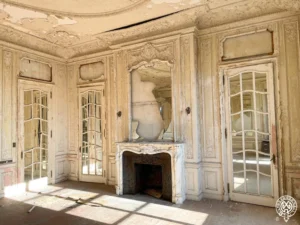
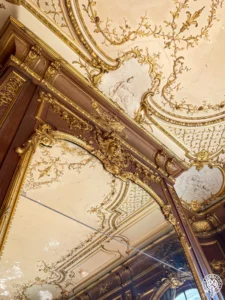 Reception room
The Decline and Preservation Efforts
In the latter half of the 20th century, Lynnewood Hall began to fall into a state of disrepair. The mansion’s size and maintenance costs proved to be a significant burden for its owners, and by the 1970s, the estate was in need of extensive restoration work. The property was sold several times, and at one point, it was even threatened with demolition.
However, efforts to preserve the mansion gained momentum in the 1990s, as local preservationists and historical societies recognized the significance of Lynnewood Hall as an architectural and cultural landmark. In 1998, the property was designated as a historic landmark by the Philadelphia Historical Commission, which helped ensure its protection from demolition.
Despite these efforts, Lynnewood Hall still faces ongoing challenges related to its upkeep. The estate has changed ownership several times in recent years, and its future remains uncertain. However, the mansion continues to attract interest from those who appreciate its historical and architectural value. The property has also become a sought-after location for film and television productions, further cementing its status as a cultural icon.
Conclusion
Lynnewood Hall is a breathtaking example of Gilded Age grandeur, and its rich history and architectural beauty make it a unique and valuable piece of Philadelphia’s heritage. From its stunning design to its association with one of America’s wealthiest families, the mansion offers a glimpse into a bygone era of luxury and excess. While the estate faces ongoing challenges in terms of preservation, its legacy endures, and it remains a symbol of the ambition and vision of those who built it. As Philadelphia continues to evolve, Lynnewood Hall stands as a testament to the city’s historical importance and the lasting impact of its most influential families.
For those who are fortunate enough to visit Lynnewood Hall, the mansion offers an unforgettable experience, transporting them back in time to an age of elegance, sophistication, and grandeur. Its enduring beauty and cultural significance ensure that Lynnewood Hall will remain a cherished landmark for generations to come.