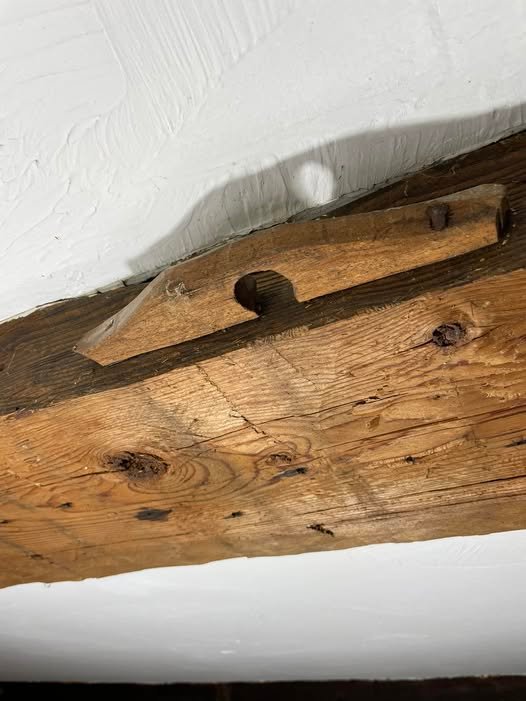
We moved into our 1770 house almost a month ago and I’m enjoying finding things. Any idea what this could have been used for? It’s attached to a beam.
We moved into our 1770 house almost a month ago and I’m enjoying finding things. Any idea what this could have been used for? It’s attached to a beam.
Some of the people opinions on it:
- It most likely had an opposite number and they supported a pole across the ceiling for clothes, herbs, ham, or anything else you needed to keep off the ground.
- We have one in our house (1870) in Finland. They were used to support a pole from which a spinable contraption was used for rug making. Probably had many uses connected to weaving, spinning, hemp production, etc.
- If this is in your Kitchen or pantry, it may have been installed to hang herbs that are drying. (and the idea of a lantern is okay too)
-
When we gutted some of the rooms in our house after a minor fire, we found some interesting fixes and work around from the previous owner. It was a modular home that had some add ons. The owner was a friend of my dad, so dad knew he had a habit of not wasting a scrap of wood or anything worth hanging on to.Reclaimed wood from old boats was a common item
- This house had some of these or look alike and it was to hold the closet rod in place.. I took them out myself.. Pipe went right in the hole of course. 1900 folk’s may do with what they had to use… Million different things this could have been for..
- Dye & Hook. Get an old wood handle broom. Cut it as long as you want. Drill hole close to top of handle all way through stick it through the hole knock pin in handle then you can run little dye rods around it to hang stuff with on. But it’s probably a Flower pot hanger.
- In days of old, when knights were bold, and women weren’t invented, they drilled holes , in wooden poles and walked away contented.
- Reminds me of a ship cleat. Like to wrap rope in the hole and then around the sides to teather.
- To me it looks like a kind of early spirit level.

- Used for drying flowers. Hang them in a bunch upside down.
What do you think? Tell us in the facebook page comment!
Facebook Comments Box