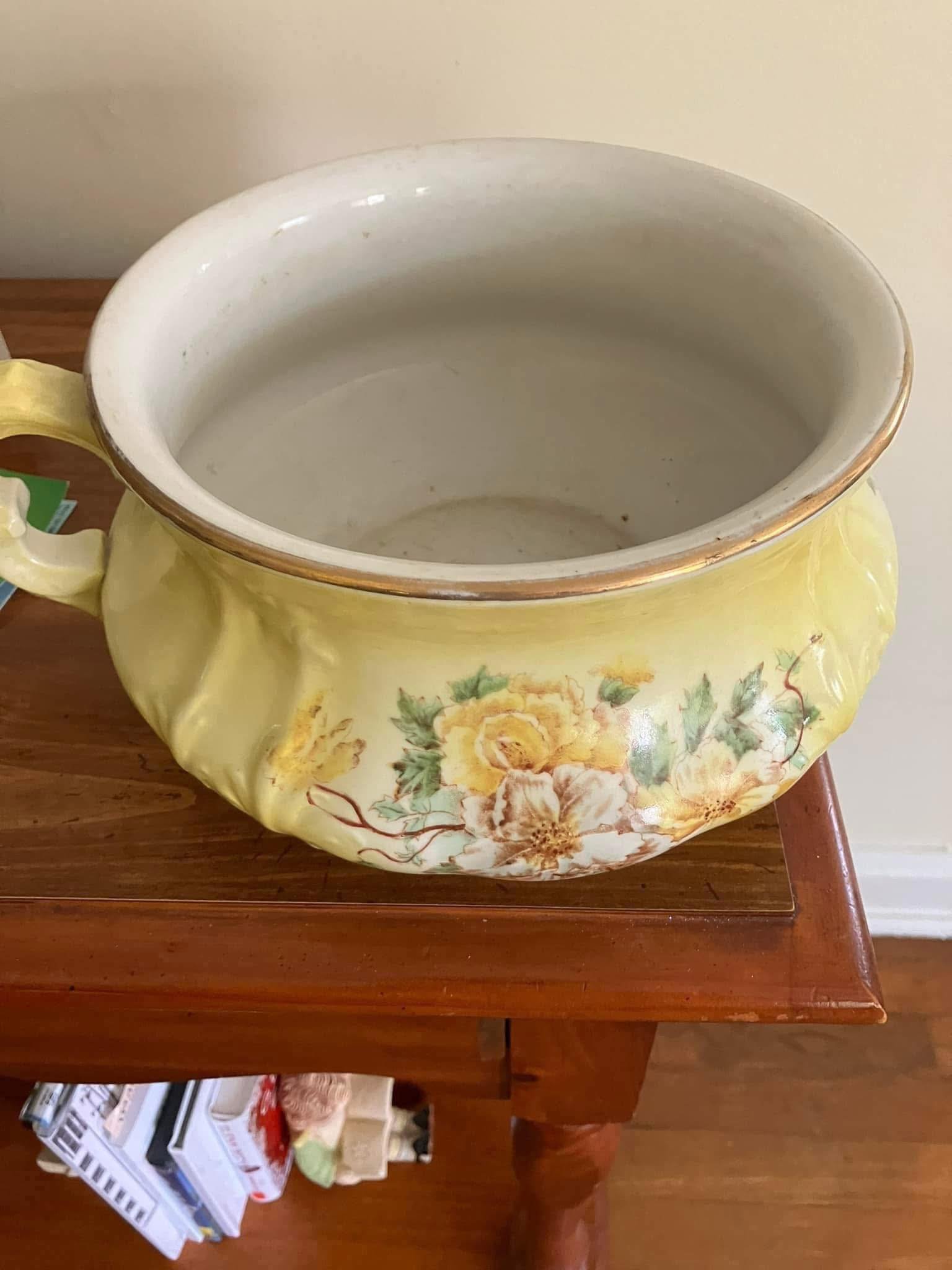
Found this beautiful “bowl” in the glassware section at Goodwill. I really don’t think it belonged there if it was used for what i think it was.
Some of the people opinions on it:
- Kathy LaCroix: I believe it is a very beautiful chamber pot… so plant a flower in it and turn it into a flower pot.
- Ettie Palmer Skivington: It goes under the bed to pee in.
- Linda O’Neill: I think it’s a chamber pot.
- Kathy Johnson: That is a chamber pot—unfortunately you’re missing the lid. I used to collect them and had a beautiful full set.
- Shelley Snyder: There’s a great Facebook group called “My Antiques Identified” that can help with things like this.
- Tim Morse: That’s a bedside pee pot.
- Doug Maclennan: A giant tea cup.
- Harveylene Lynch Peterson: Why not—it’s a porcelain potty.
- Eddie York: I thought this was about abandoned mansions—when did it become Goodwill hunting?
- Joyce Williamson: It’s a “Jerry.”
- Charles Wagner: What a great soup bowl—yummy! Doesn’t anybody know anything?
- Nancy R. Kirk: It’s funny how they used to decorate chamber pots—like in a time of need, who really cares?
- Judi Rac: One of my local Facebook pages was advertising a “bowl” like this—clearly someone young.
- EuniceAnn Opfer: A pretty potty.
- Barbara D’Estrada: I bet it’s a Nippon cup, marked on the bottom. I used to collect them—very pretty, though not very valuable.
- Kelley Terhark: Put flowers in it and call it a day.
At first glance, it looked like just another overlooked treasure tucked between mismatched plates and cloudy drinking glasses. The kind of object you might pass by without a second thought. But something about it stood out—a quiet elegance, a sense of purpose that didn’t quite align with the ordinary glassware surrounding it. It was labeled simply as a “bowl,” placed casually on a thrift store shelf, yet it seemed to carry a story that hadn’t been properly recognized.
The piece itself was undeniably beautiful. Its form was deliberate, not merely functional but expressive. The curves were too intentional, the proportions too refined to belong to something meant solely for serving salad or holding fruit. Light caught its surface in a way that suggested craftsmanship, perhaps even artistry. It felt less like a kitchen item and more like an object that had once held significance beyond the everyday.
This is often the quiet intrigue of secondhand spaces—objects lose their context. What was once meaningful becomes ordinary simply because its story has been forgotten. In this case, the “bowl” seemed to have been stripped of its identity, reduced to a vague category that failed to capture its original purpose. And yet, for someone paying attention, the clues remained.
Its depth, its shape, the way it was designed to be held or positioned—these details hinted that it may not have been intended for food at all. Perhaps it once belonged in a completely different setting, used in a way that carried ritual, decoration, or even symbolism. There was a subtle suggestion that it had lived another life, one that didn’t quite fit among stacks of everyday dishware.
Moments like this reveal how easily meaning can shift over time. An object created with intention can become detached from its origin, especially when it changes hands without explanation. What was once obvious to its original owner becomes a mystery to the next. And in places like thrift stores, where items arrive without labels or histories, those mysteries quietly accumulate.
There is also something compelling about the act of noticing. Many people might have walked past that shelf without a second glance, seeing only a random assortment of glass items. But recognizing that something feels “off”—that an object might not belong where it has been placed—requires a certain attentiveness. It’s a reminder that not everything is what it seems, especially when context is missing.
The idea that this “bowl” may have been miscategorized adds to its charm. It transforms the object from a simple find into a small puzzle. What was it originally used for? Who owned it before? How did it end up here, quietly waiting to be rediscovered? These questions linger, giving the piece a sense of depth that goes far beyond its physical appearance.
In a way, this kind of discovery reflects a broader truth about objects and the stories they carry. Items are not just things—they are extensions of moments, habits, and intentions. When those connections are lost, the object doesn’t lose its essence entirely, but it becomes open to reinterpretation. It invites the next person to assign new meaning, or perhaps to rediscover the old one.
Finding something like this in an unexpected place is more than just a lucky thrift store moment. It’s a reminder that history often hides in plain sight, disguised as something ordinary. And sometimes, all it takes is a bit of curiosity to recognize that what appears simple may actually hold a far more interesting story beneath the surface.
That “bowl,” sitting quietly among everyday glassware, is no longer just an object—it’s a question waiting to be answered.