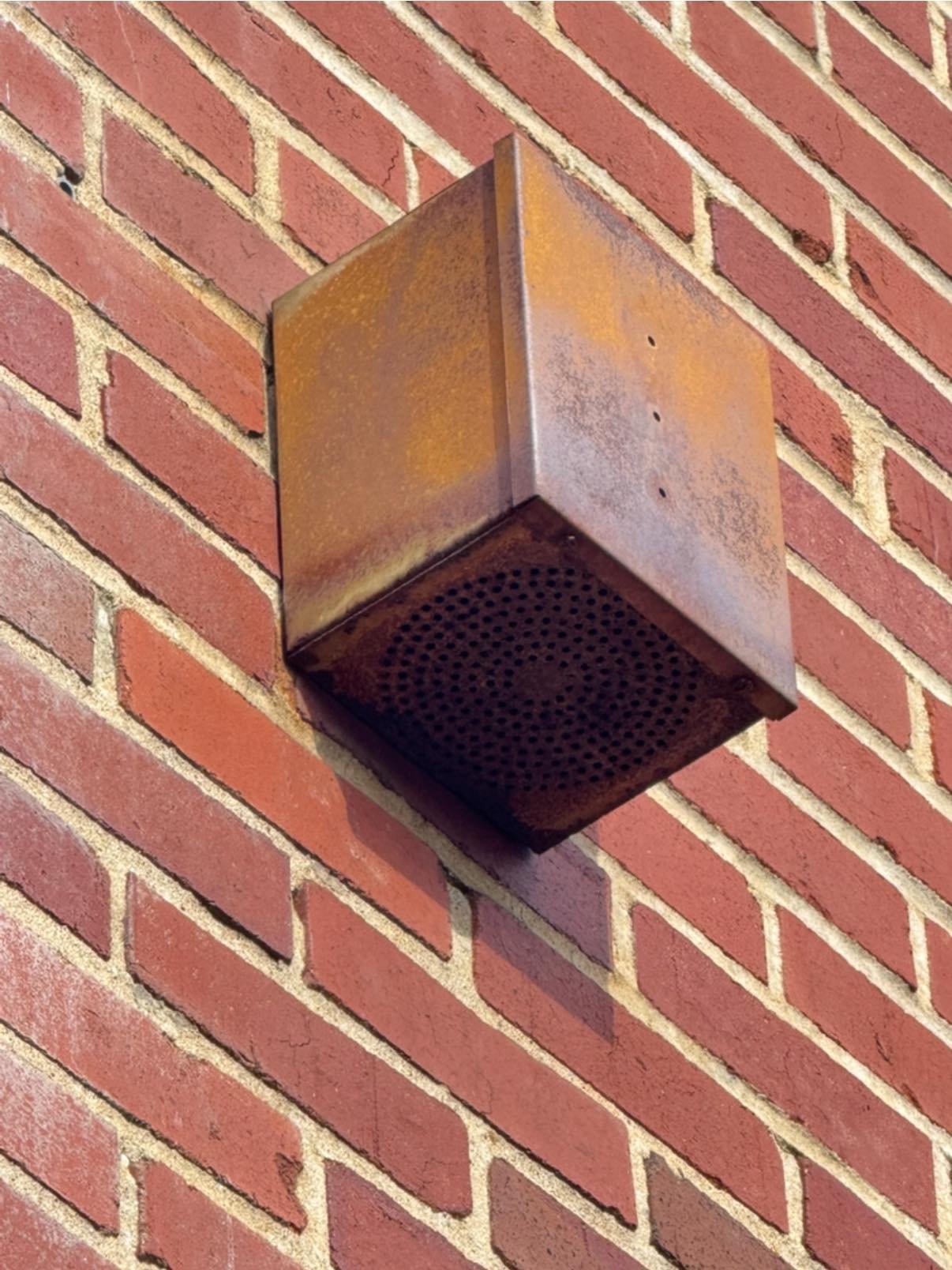
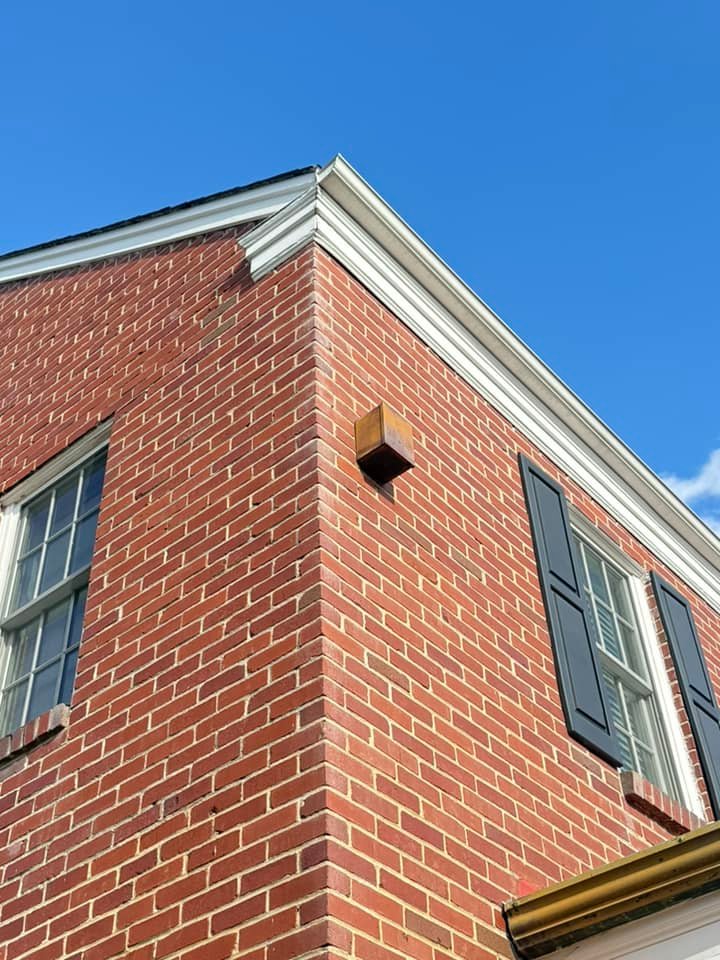
1. Not a batbox. Usually an alarm box. my grandfathers store that was built in the early 50’s had one just like it. til it was broken into in the early 2000’s and they knocked if off the wall thinking it was still active
4. We had an alarm system put in our house in the early 1980s. We have boxes like this on the corners of the house that contained the sirens.
5. Hard wired fire alarm. Probably was once monitored by local alarm co.
6. We have these on the mid century townhouses in my neighborhood in Baltimore. We have a bird family that nests inside ours each year. Would be cool if bats lived there.
7. Bottom might just be vented in insure no moisture buildup. Could house an electrical control or switch. Edit: But I like the idea of an alarm.
8. I didn’t know bats existed small enough to get through those little holes in the bottom. It is a metal box with speaker holes at the bottom put up high enough somebody could not easily disable it. Probably an old security alarm siren that was painted to blend in with the brick. If it was for an exhaust fan it woukd have been higher in the gable end and have larger holes to keep them from clogging up.
9. We have a brick colonial also, does around your windows at brick leak?
10. We had one similar. Turned out to be an external ringer for the telephone. Lol got a landline when we moved in to get a bundle deal with internet. Never got an actual phone. Once in a while, the thing would make this weird noise a few times, then stop. Took forever to figure out what it was.
What do you think?
—————————————————————————–
Old houses have a way of whispering their stories—sometimes literally.
A slight indentation in a hallway, a ghost of a doorframe where none exists, or an unfamiliar metal fixture can instantly become a puzzle that tugs at the imagination. In this case, the mystery centers around a curious object attached to the exterior of a 1930s brick Colonial in northern Virginia—something that looks suspiciously like a speaker, but almost certainly isn’t.
At first glance, its design suggests an audio connection: a metal faceplate, openings or perforations for sound, and a symmetrical shape. It’s easy to imagine voices echoing from inside, perhaps like an old drive-through intercom or a homeowner paging someone indoors. But while a modern observer might jump to the idea of a communication device, this feature dates to a period when radio and telephone technology hadn’t yet reached such integration into everyday construction.
So what is this mysterious box?
A Clue from Its Era
The home’s dating—1930s Colonial Revival—is already a strong hint. The early decades of the 20th century saw a leap in residential mechanical systems. Electricity became standard. Central heating replaced wood and coal in many regions. Even passive ventilation solutions were engineered right into the brickwork.
Those assumptions narrow the possibilities dramatically.
Possibility #1: A Laundry or Kitchen Vent
One of the most common “speaker-looking” exterior fixtures from this period is actually a vent—usually for a stove or laundry area.
In the 1930s, homeowners still relied on heat-generating appliances that produced moisture and odors. Kitchen ranges, especially early gas models, were notorious for this. Rather than ducting into the attic or roofing (a later standard), houses often vented straight through the wall.
If the box sits near a kitchen wall, that’s the leading theory.
The patterned openings would have allowed fumes to escape while preventing small animals or debris from entering.
Possibility #2: A Coal or Boiler Draft Vent
Many 1930s homes still relied on coal, oil, or early boiler systems.
Mechanical ventilation was a necessity—heat was powerful but air-hungry. These systems often included small exhaust ports or “draft regulators” that balanced the pull of air for combustion.
A box like this may have been an exterior output for a furnace room or basement boiler, especially if it sits lower on the wall.
Possibility #3: A Mail Slot or Message Port
Although less common, some houses—particularly East Coast and Mid-Atlantic residences—featured mailbox slots mounted directly onto exterior brick.
A full mail chute in the wall was more typical, but decorative grilles or perforated faceplates occasionally appeared in transitional designs.
If the opening doesn’t appear to lead into a room at all, however, this becomes less likely.
Possibility #4: A Servant Call System or Early Intercom
Here’s where the fantasy of an actual “speaker” brushes closest to the truth. Large estates and upper-middle-class homes sometimes included rudimentary call systems—push buttons, bells, and mechanical buzzers—not unlike those used in hotels.
However, true audio intercoms weren’t installed in most American middle-class homes until decades later, and the majority of call panels were placed indoors, not outside.
Still, if wiring traces seem present—or the piece is located near a former side or service door—this idea remains a fascinating possibility.
Why the Feature Feels So Strange Today
Modern construction hides everything—vents, wiring, mailboxes, meters—behind trim, siding, soffits, or discrete openings.
A 1930s builder, by contrast, mounted many necessities proudly on the exterior walls, often casting them in metal designed to last.
Weather, paint, brick cleaning, and time wear away context.
Remove the appliance, cover an interior pipe chase, or remodel a kitchen, and suddenly the exterior relic seems mysterious—almost alien.
A Small Fixture With a Larger Story
Whatever its exact identity—vent, draft outlet, mail port, or mechanical mount—this small, perforated feature likely played a quiet but essential role in the daily rhythm of the house nearly a century ago.
A reminder that homes evolve, but their walls quietly keep the memory.
And while many design elements from that era have vanished behind drywall and insulation, this one survives—an architectural breadcrumb pointing to a time when engineering solutions were not hidden away, but proudly stamped in metal and left visible for generations to wonder about.
Sometimes the house speaks—not through sound, but through the things it leaves behind.