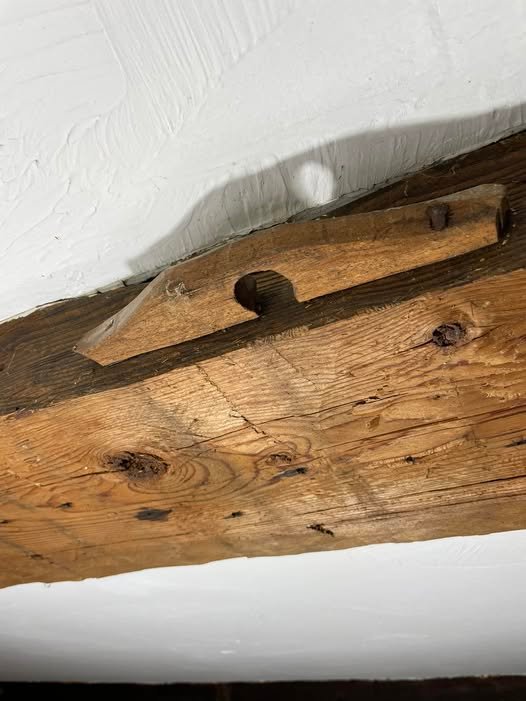
There is something magical about moving into a house that predates the very nation it stands in.
With every loose floorboard, pegged timber joint, and hand-forged nail, a home from the 1770s carries stories that stretch across centuries.
And part of the joy—perhaps the most unexpected delight—is discovering the oddities left behind inside the walls, ceilings, and beams.
In this case, the puzzle centers on a small, mysterious object attached directly to a structural beam—clearly meant to serve a purpose, yet no longer connected to anything visible. In a modern home, such a piece might stand out as a mistake. In a colonial-era structure, it becomes a clue.
A House Built for Necessity
In the late 18th century, homes were constructed with the philosophy that every element must be useful. Storage was built in, hooks and mounts sprouted anywhere a task depended on one, and rooms served multiple overlapping functions—cooking, washing, sewing, mending, storing, and sleeping often all happened under the same roof.
So a small metal bracket, block, or wooden fixture clamped to a beam wasn’t decorative. It had a job.
Possibility #1: Harness or Tack Hook
If the home once had a working barn attached—or if this room served as a transitional space—this mount might once have held leather tack:
Beams were the strongest structural members, perfect for suspending gear that needed drying, oiling, or simply hanging ready for the next trip to the barn or fields.
If the mount looks like it held weight or shows smooth wear on one side, this interpretation carries weight too.
Possibility #2: Drying Hook or Hanging Bar
Food preservation was a constant duty.
Colonial homes dried everything: herbs, onions, fish, salted meats, even hides.
Beam-mounted hangers were common in:
A small fixture could have supported a crossbar where bundles—or sometimes full hams—hung well above pests and airflow.
Possibility #3: Lantern or Candle Holder
Before wall sconces became standardized, light traveled where work traveled.
It was normal to find:
-
pivoting candle arms
-
wrought-iron loops
-
braces for lantern hooks
If the piece has a nail hole or hinge point, it may once have supported a swinging arm, allowing someone to spread light in different directions while keeping hands free—vital for everything from spinning wool to repairing tools at dusk.
Possibility #4: Suspended Tools or Household Implements
Life in the 1770s was a constant cycle of work, and tools needed to stay accessible—but out of reach of children, animals, and damp floors.
Common hangers supported:
Many colonial families used overhead beams the way we use pegboards today.
Possibility #5: Part of a Removed Partition or Loft Ladder
Sometimes what remains is not the end of a story, but a fragment of a larger one.
If the object looks structural—square, bolted, or built-up—it may once have anchored:
Over time, as the home changed use—from working farm to modern residence—those secondary structures disappeared, leaving only the fastener.
Why These Odd Pieces Survive
In a house that has seen hundreds of seasons:
Modern renovations often leave beam hardware intact simply because removing it can risk damaging original timbers—or because no one knows what it did.
It stands as a tiny historical footprint of the home’s first purpose—when every object was hand-made, every beam carried a task, and there was no such thing as wasted space.
A House That Still Has Secrets
Finding such a relic is more than stumbling across an antique fastening point.
It’s a physical echo of the lives lived in your home before electricity, before motor travel, and before mass-produced hardware existed.
Whether the object once held a lantern guiding nighttime chores, supported herbs drying through the winter, or tethered a harness right off a work horse, one thing is certain:
It belonged to someone who depended on it.
And as you continue exploring your 1770 home, chances are this is only the first whisper of many—each one a clue to how families survived, worked, and lived within those same walls more than 250 years ago.
A mystery in plain sight—and a story still unfolding.